
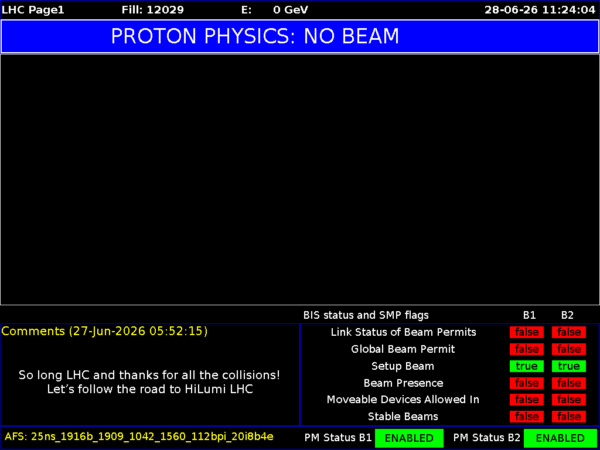
Here we are. As of yesterday LHC is switched off: even the last high-intensity tests are over (collisions had already ended on Friday), and Run 3 is definitively finished. Tomorrow, early in the morning, on 29 June 2026, Long Shutdown 3 officially begins, and it will last until the restart in 2030. [1]That's what the official schedule says, but, as we know, of the morrow there is no certainty. There are detectors to dismantle, and there's something striking about the idea of putting into storage pieces of detector that watched thousands of Higgs bosons go by for the first time in history. And there are new pieces to finish prototyping, and then to produce, install, and get working, and it's not at all simple: the number of people working today on the experiments' upgrades is not comparable to the number that conceived and built the first detectors, the complexity has increased significantly (as have the things these new detectors promise to be able to do), and the fear that not everything will go as it should is there.
During Long Shutdown 3 the LHC ring will be revolutionized from top to bottom to turn it into what we call the High-Luminosity LHC, the "high luminosity" run of LHC. Twenty years ago, when the machine had not yet produced a single collision, HL-LHC was an acronym on a slide that older colleagues would show us to say this is what comes next, and the next is now. About luminosity and what it means we've talked several times on these pages, and I'll let you go back and reread to refresh your memory. In brief, let's just say it measures how many collisions we manage to pack into the same instant at the same point, and therefore how many rare events we can hope to see. Behind the promise of LHC's "high luminosity" lie 15 years that will collect 7 times as many collisions as those accumulated so far, and will allow, among other things, the chance to see the simultaneous production of two Higgs bosons, a rare event that would make it possible to measure how strongly the Higgs boson interacts with itself, and to add the measurement of the last missing piece of the Standard Model. Run 3 will perhaps already let us glimpse its shadow, a few compatible events drowned in an enormous background. Here too the hope is great, and the next two or three years will be full of work to do for the analyses as well. Stay tuned.
Note
| ↑1 | That's what the official schedule says, but, as we know, of the morrow there is no certainty. |
|---|

Lascia un commento