
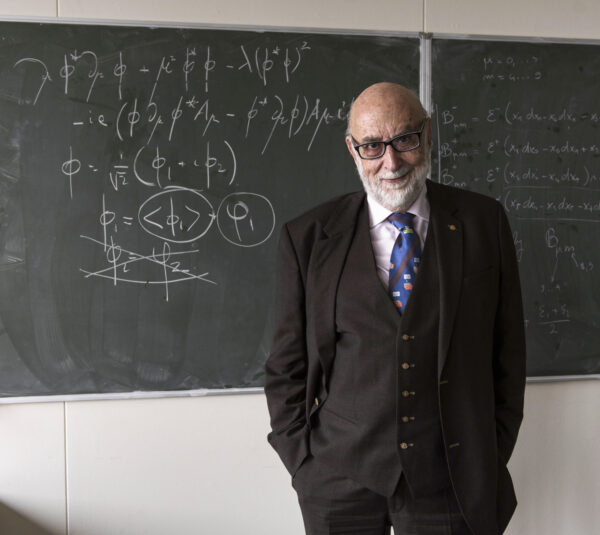
Francois Englert, who invented, together with his colleague Robert Brout and in parallel with Peter Higgs, the mechanism of electroweak symmetry breaking that we commonly call the Higgs mechanism, or better, the Brout-Englert-Higgs mechanism, passed away a few days ago at the age of 93. Englert had shared with Peter Higgs the 2013 Nobel Prize in Physics, precisely for the invention of the BEH mechanism confirmed by the discovery of the Higgs boson in 2012.
I had written about him on more than one occasion on these pages, the first time in 2009, when I met him in person at the Blois conference, where I was presenting our projections of what we thought we might discover and measure of the Higgs boson as soon as LHC began taking data. Aware of his presence at the conference, I had changed my slides a little to avoid irritating him by calling the mechanism the "Higgs" one rather than the "BEH mechanism". I believe Englert always felt a certain jealousy towards Peter Higgs, whose name is known even outside the circle of particle physicists. What is certain is that over the years he had tried more than once to re-establish a historical primacy over Higgs, in a manner that, in my view, was not always the most elegant.
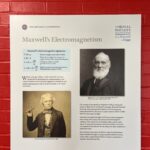
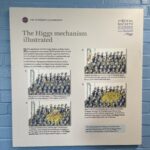
I spent a few days of last week in Edinburgh, where an ATLAS workshop was being held and where on Friday morning I gave a sort of lecture for our younger collaborators. The University of Edinburgh was, among other things, the academic home of Peter Higgs, who is of course the local pride of the physics department. On the walls of the James Clerk Maxwell Building there stands an exhibition "from Maxwell to Higgs", which I photographed and share here. Perhaps it is indeed local pride, but the exhibition does not neglect to underline the reason why the mechanism of electroweak symmetry breaking is called "Brout-Englert-Higgs", while the boson is only "Higgs". It is a story I have told many times during conferences or to my students, but perhaps never on these pages, and perhaps this is the right occasion to do so.







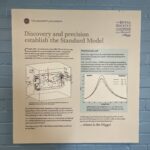



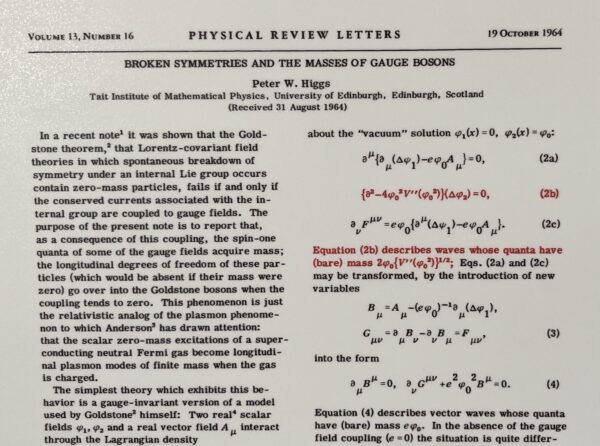
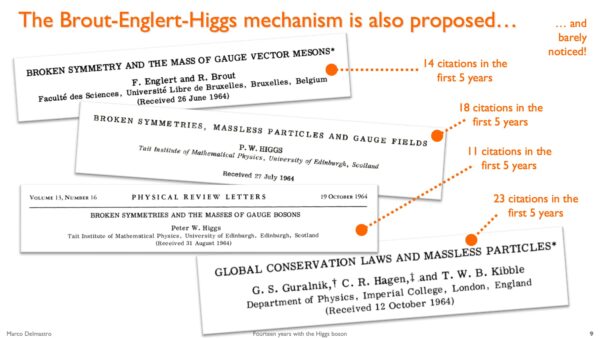
It is certainly true that the seminal article by Brout and Englert comes out first, in August 1964. Higgs publishes a first, very similar article in September of the same year [1]so in fact after the one by Brout and Englert, even if the value of a difference of a few weeks is debatable: how much of this "delay" is due to editorial matters? and then another, slightly more detailed, in October of the same year. This second article is rejected by the journal as not truly innovative with respect to the works just published: the editors ask Higgs to propose some significant addition to justify publication. Higgs then literally adds three lines to the article, explaining how, if one solves the wave equations of the vacuum states of the system he has just described, the necessity of a new physical state pops out, one that would manifest itself as a scalar boson, the one that years later everyone would call, precisely, the Higgs boson. Three extra lines that change the journal editor's mind, who accepts the article for publication, but that also change the toponymy of the story. Was there the possibility of the existence of the Higgs boson in the equations of Brout and Englert's article? Yes, certainly. Was that possibility explicitly explored and presented? No, it would be Peter Higgs who did so first, in his October 1964 paper, and who deserves to have his name associated with the particle.
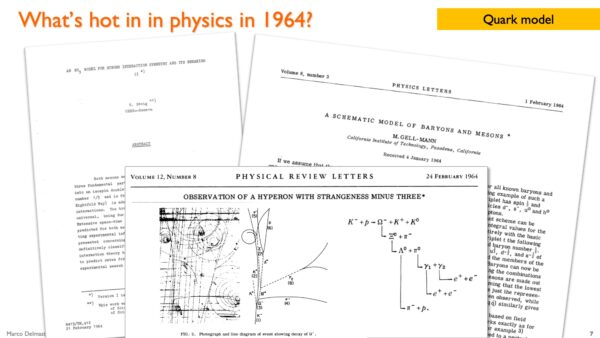
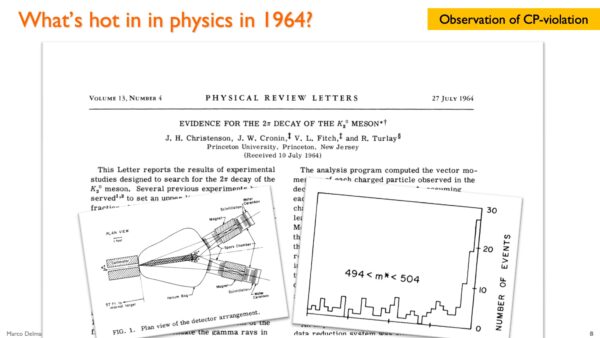
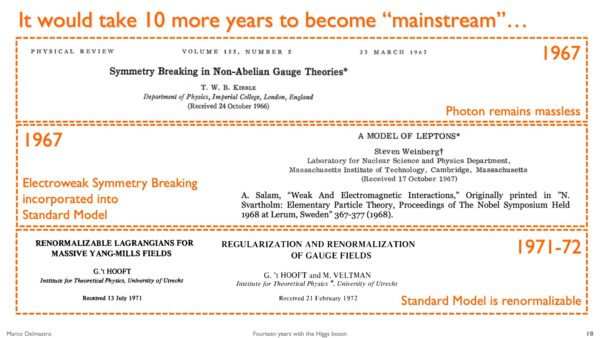
The story could continue well beyond this, I often tell it at the beginning of seminars. Beyond the questions of primacy, the articles by Brout and Englert, by Higgs, or by the English colleagues Guralnik, Hagen and Kibble, are in fact deeply ignored in 1964, and it will take about a decade before the original idea becomes "mainstream" in theoretical particle physics. Why? Because the BEH mechanism on its own is not very useful unless it is integrated into the structure of the Standard Model, and this work will be done by Glashow, Salam and Weinberg at the end of the 1960s, and then made mathematically solid by 't Hooft and Veltman with the proof of the renormalizability of the theory. All of them will win the Nobel long before Englert and Higgs [2]Glashow, Salam and Weinberg in 1979 for electroweak unification, 't Hooft and Veltman in 1999 for renormalizability, because their integration of the original idea is decidedly more important and profound than the idea itself [3]which, by the way, is not even all that new: spontaneous symmetry breaking was at the time a concept already widely used and studied, for example in the context of the physics of materials and superconductivity. But that is another story.
As much as Peter Higgs was shy and humble, Francois Englert was flamboyant and extroverted. In the end the names, the race, the priorities claimed for fifty years are only our bookkeeping: the field is really there, and both of them had imagined it in 1964, long before our experiments deigned to prove them right.
Note
| ↑1 | so in fact after the one by Brout and Englert, even if the value of a difference of a few weeks is debatable: how much of this "delay" is due to editorial matters? |
|---|---|
| ↑2 | Glashow, Salam and Weinberg in 1979 for electroweak unification, 't Hooft and Veltman in 1999 for renormalizability |
| ↑3 | which, by the way, is not even all that new: spontaneous symmetry breaking was at the time a concept already widely used and studied, for example in the context of the physics of materials and superconductivity. But that is another story |

Lascia un commento